Who "stole" the electric motor efficiency? 1% efficiency improvement means a lot!
Jak poprawić wydajność silnika elektrycznego?
Porozmawiajmy dzisiaj na ten temat.
Silniki o wysokiej sprawności są bezpośrednio powiązane z polityką oszczędzania energii i redukcji emisji, a wiele kluczowych projektów krajowych i projektów komunalnych składających oferty na silniki elektryczne musi spełniać wymagania oceny efektywności energetycznej IE3, szczególnie w przypadku silników elektrycznych wprowadzanych do krajów europejskich poprzez eksport, wymagania te stanowią prawie próg minimalny.
However, it is too difficult for electric motor manufacturers to improve efficiency, and there are many bottleneck technologies to be broken, such as the determination of loss, the determination of key factors affecting electric motor efficiency, the causes of loss and quantitative analysis, etc.
The following is a breakdown and analysis of the causes of loss increase, starting from the causes of loss increase one by one.
(1) Large wire resistivity or small wire diameter, uneven wire diameter or less number of parallel winding roots.
(2) Wiring error or poor welding.
(3) The actual number of turns is more than the design value.
● High stator current.
(1) Other losses are large.
(2) Asymmetry of stator winding makes the three phases unbalanced.
(3) Serious uneven air gap of stator and rotor.
(4) The resistance will be less than the normal value at this time because the number of turns is less than the normal value.
(5) the winding wiring is incorrect.
Large rotor copper loss
● Rotor winding (or guide bar) resistance is large.
(1) the resistivity of aluminum (copper) is large.
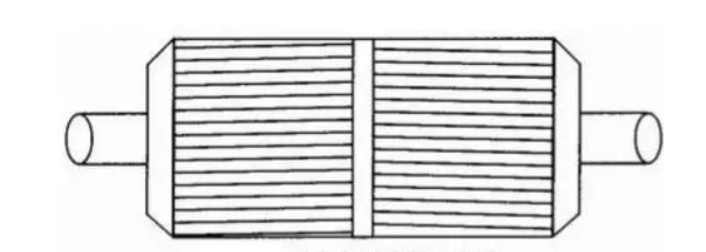
(2) cast aluminum rotor guide bar or end ring inside the air with air holes or impurities, or due to casting defects resulting in local problems with thin bars.
(3) the stator slot is not neat (manifested as slot serration), there is a wrong piece, anti-piece, resulting in the effective area of the rotor slot is not enough.
(4) because of improper selection of casting parameters leading to loose aluminum organization, which directly leads to increased resistivity.
(5) material does not meet the requirements, such as ordinary aluminum rotor using alloy aluminum.
(6) Using the wrong rotor, etc.
● High rotor current.
(1) Using the wrong rotor.
(2) Wrong aluminum is used when casting aluminum, such as alloy aluminum rotor using ordinary aluminum.
(3) The rotor core is not stacked solidly, resulting in a large area of aluminum between the pieces, resulting in excessive rotor transverse current.
Large stray loss
● Improper selection of stator winding type or pitch.
● Improper selection of stator and rotor slot fits.
● Air gap is too small or seriously uneven.
● Severe short circuit between rotor guide and core.
Stator winding end is too long, etc.
Large iron loss
The quality of silicon steel sheet is poor or the material is used wrongly,
for example, 600 material is wrongly used as 800, which is a reduced grade;
the problem should be paid special attention to the electric motor factory of outsourcing iron core.
● Poor insulation between stator core pieces.
(1) No insulation treatment or poor treatment effect.
(2) The pressure is too high when the core is stacked, so that the inter-sheet insulation is damaged.
(3) Short circuit between core piece and piece when turning the stator bore or repairing and filing the core (the problem exists in most of the core manufacturing plants).
● Insufficient number of core pieces and insufficient iron weight.
(1) Insufficient number of code pieces (missing pieces).
(2) The stacking pressure is small and not compacted, as a direct result of which the iron weight is insufficient.
(3) Large burrs in the punching sheet, and the iron weight cannot be guaranteed when the iron length is in line.
(4) The paint is too thick, which is a direct quality problem of the silicon steel sheet.
● The magnetic circuit is too saturated, and the no-load current vs. voltage curve is bent more seriously at this time.
● No-load stray loss is large, because it is included in the iron loss during the test, making the iron loss appear larger.
● When the winding is removed by fire or electric heating, the core is overheated and the magnetic conductivity decreases and the inter-piece insulation is damaged.
This problem mainly occurs when the winding is removed by fire after a winding failure;
some induction motors manufacturers have sought a way to remove the winding by soaking it in lye.
High mechanical loss
● The bearing or bearing assembly quality is not good, at this time the bearing will be seriously heated or inflexible in rotation.
● Wrong external fan (such as 2-pole motor using a 4-pole fan) or wrong fan blade angle; according to the conventional design, the fan of 2P motor is relatively small, and the method to reduce the loss by adjusting the fan method is very effective, but the premise is to ensure the temperature rise performance of the smart motors.
● The housing and the two end caps bearing chambers are not on the same axis.
● The bearing chamber diameter is small, which makes the outer ring of the bearing deformed by pressure and causes the bearing friction loss to increase; the situation may also lead to the bearing overheating failure at the same time.
● Too much grease or bad quality of grease in the bearing chamber.
The problem is obvious in the high-voltage motor, there was a test, the highest point of the bearing cover temperature is 10K higher than the lowest point, open the check, the location of the grease does accumulate more.
● The stator and rotor are rubbing each other, which is what we call sweeping.
When the stator and rotor are rubbing each other, it is not so much that it directly causes the electric motor not to rotate, but the electric motors loss increases obviously.
● The rotor axial size is incorrect, causing the top dead at both ends and making the rotation inflexible.
● Parts such as oil seal or water dumping ring are not installed correctly or deformed, resulting in large frictional resistance.
The fan is rubbed against the associated parts of the electric motors, resulting in poor rotation.
The efficiency of the electric motor, mainly when the design selection has been determined, such as permanent magnet synchronous motor efficiency is higher than the AC asynchronous energy efficient motors, the need for high efficiency work, you need to choose a servo control mechanical and electrical systems, rather than variable frequency speed system, of course, the cost is more money, so the maximum efficiency is closely related to the cost.
To improve electric motor efficiency, the essence is to reduce electric motor losses, electric motor losses are divided into mechanical losses and electromagnetic losses.
For example, for AC asynchronous electric motors, the current through the stator and rotor windings, will produce copper losses and conductor losses.
The magnetic field in the iron will cause eddy currents and thus bring hysteresis losses.
Breath magnetic field high harmonics will produce stray losses on the load, bearings and fan rotation do process will have wear losses.
To reduce the rotor loss, you can reduce the resistance of the rotor winding.
The use of thicker and lower resistivity of the wire, or increase the slot cross-sectional area of the rotor, the material is of course very critical, there are conditions to produce copper rotor, the loss will be reduced by about 15%.
The current asynchronous motors are basically aluminum rotor, so the efficiency is not so high.
The same stator has the same copper loss, can increase the stator slot sub, increase the full slot rate of the stator slot, can also shorten the stator winding end length.
If the use of permanent magnets to replace the stator winding, no current through the, of course, can obviously improve efficiency.
This is also the fundamental reason why synchronous motors are more efficient than asynchronous motors.
Straty żelaza w silniku, można zastosować dobrej jakości blachę ze stali krzemowej, zmniejszyć utratę histerezy lub wydłużyć długość rdzenia, można zmniejszyć gęstość strumienia, można również zwiększyć powłokę izolacyjną, oprócz procesu obróbki cieplnej jest również bardzo krytyczny.
Ważniejsza jest wydajność wentylacji silnika elektrycznego, temperatura jest wysoka, oczywiście straty będą bardzo duże, można zastosować odpowiednią konstrukcję chłodzącą lub dodatkowe metody chłodzenia, aby zmniejszyć straty tarcia.
Wysokie harmoniczne, które generują straty błądzące w uzwojeniu i rdzeniu, mogą poprawić uzwojenie stojana, redukując powstawanie wysokich harmonicznych, a także zmniejszyć efekt szczeliny magnetycznej poprzez obróbkę izolacyjną powierzchni żłobka wirnika i zastosowanie błota szczeliny magnetycznej.
Lektura rozszerzona: Jak zdefiniować silnik o wysokiej sprawności energetycznej?
Ordinary motor: motor is a device that converts electrical energy into mechanical energy, 70%-95% of the electrical energy absorbed by the electric motor is converted into mechanical energy, which is often referred to as the energy efficient motors, it is an important technical index of the motor, the remaining 30%-5% is consumed by the motor itself due to heat and mechanical loss, so this part of the electrical energy is wasted.
High-efficiency motor:
The motor with higher utilization of electric energy is called high-efficiency motor, referred to as "high-efficiency motor".
For ordinary motors, it is not easy to increase the efficiency by 1 percentage point, and the material will be increased a lot, and when the electric motor efficiency reaches a certain value, no matter how much material is increased, it cannot be improved.
Most of the high-efficiency electric motors on the market now are the newer products of three-phase asynchronous motors, that is to say, the basic working principle has not changed.
High Maximum efficiency motors mainly improve the efficiency of motors by the following ways.
1、Zwiększ zewnętrzną średnicę żelaznego rdzenia, zwiększ długość żelaznego rdzenia, zwiększ rozmiar szczeliny stojana, zwiększ ciężar drutu miedzianego, aby osiągnąć cel wydajności, na przykład: silnik Y2-8024 zwiększy średnicę zewnętrzną z Φ120 do Φ130, niektóre zagraniczne kraje zwiększają Φ145 i zwiększają długość z 70 do 90. Do produkcji używa się 3 kg żelaza i 0,9 kg drutu miedzianego każdy silnik elektryczny.
2. Używanie blachy ze stali krzemowej o dobrej przewodności magnetycznej, blachy walcowanej na gorąco z dużą utratą żelaza w przeszłości, ale obecnie używa się wysokiej jakości blachy walcowanej na zimno o niskiej stracie, takiej jak DW470 lub nawet niższej DW270.
3, popraw dokładność przetwarzania, zmniejsz straty mechaniczne, wymień małe wentylatory, aby zmniejszyć straty wentylatorów za pomocą łożysk o wysokiej wydajności.
4, the electrical performance parameters of the electric motor to optimize the design, by changing the slot shape and other parameters of optimization.
5, zastosowanie odlewanego wirnika miedzianego (złożony proces, wysoki koszt).
So to make a real high efficiency motor, in the design, raw materials, processing are much higher costs, in order to make the maximum conversion of electricity into mechanical energy.
Energy-saving measures for high efficiency motors
Oszczędność energii silnika to inżynieria systemowa obejmująca cały cykl życia silnika, od projektu silnika, produkcji po wybór silnika, obsługę, regulację, konserwację i złomowanie. Efekt środków oszczędzania energii należy rozpatrywać w całym cyklu życia silnika, a poprawę wydajności rozważa się głównie w kraju i za granicą pod kątem następujących aspektów w tym zakresie.
Konstrukcja silnika energooszczędnego odnosi się do zastosowania nowoczesnych metod projektowania, takich jak technologia projektowania optymalizacyjnego, technologia nowych materiałów, technologia sterowania, technologia integracji oraz technologia testowania i kontroli w celu zmniejszenia strat mocy silnika, poprawy wydajności silnika i zaprojektowania silnika o wysokiej wydajności.
Zamieniając energię elektryczną na energię mechaniczną, sam silnik również traci część energii.
Typową stratę w silniku prądu przemiennego można ogólnie podzielić na trzy części: stratę stałą, stratę zmienną i stratę błądzącą. Zmienne zmiany strat wraz z obciążeniem, w tym utrata rezystancji stojana (utrata miedzi), utrata rezystancji wirnika i utrata rezystancji szczotek; stała strata nie jest związana z obciążeniem, włączając straty w rdzeniu i straty mechaniczne.
Strata żelaza składa się ze straty histerezy i straty prądu wirowego, proporcjonalnych do kwadratu napięcia, przy czym strata histerezy jest również odwrotnie proporcjonalna do częstotliwości;
inne straty bezpańskie to straty mechaniczne i inne straty, w tym straty w wyniku tarcia łożyska oraz straty w wentylatorze, wirniku i inne straty w oporze wiatru spowodowane obrotem.
The characteristics of high efficiency motor
1, Oszczędzaj zużycie energii, redukuj długoterminowe koszty operacyjne, bardzo odpowiednie dla tekstyliów, wentylatorów, pomp, sprężarek, oszczędzając energię przez rok, aby odzyskać koszty zakupu silnika.
2, rozruch bezpośredni lub kontrola prędkości za pomocą przetwornicy częstotliwości, mogą w pełni zastąpić silnik asynchroniczny.
3, sam energooszczędny silnik z magnesami trwałymi ziem rzadkich może zaoszczędzić ponad 15 ℅ energii elektrycznej w porównaniu ze zwykłymi silnikami.
4, Electric motor electrical input power factor close to 1, improve the quality of the grid factor, no need to add power factor compensator.
5, the electric motor current is small, saving transmission and distribution capacity, extending the overall operating life of the system.
6, power saving budget: 55Kw motor for example, high efficiency motor than the general motor power saving 15%, electricity cost per degree by 0.5 yuan, the use of energy-saving motor within a year by power saving can recover the cost of replacing the motor.
Any inquiry for high efficiency motor, please find the professional electric motor in China - Dongchun motor here.
 Przejdź do treści